
I spend a great deal of time watching how tourism brands move from a beautiful moment in the field to an actual booking. Not as a marketer chasing the latest channel, but as a tourism operator and technology enthusiast trying to understand why so much obvious demand quietly evaporates between the photo and the payment.
The pattern is remarkably consistent. The capture is excellent. The reach is real. And then, somewhere between "I want to go there" and "I have booked," the whole thing falls apart.
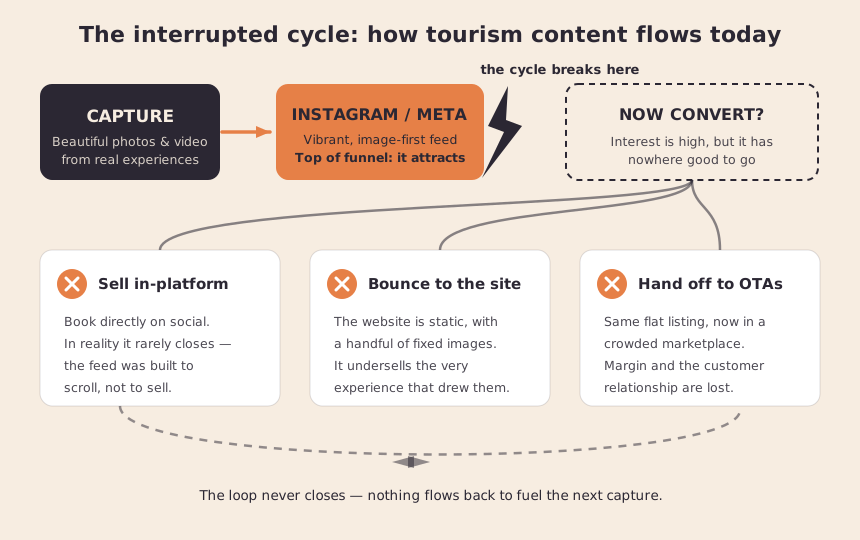
The workflow most tourism brands actually run
Strip away the branding and the workflow looks almost identical across operators.
You go out and capture the experience. The light is good, the guests are happy, the landscape does the selling for you. Those photos and short videos go straight to Instagram, where they belong: the feed is image-first, fast, and genuinely vibrant. This is the part the industry has mastered. Tourism is arguably the single best-suited category for social media, and it shows.
A handful of those images also make their way onto the website. Usually a few per page, chosen once, then left untouched for a year or more. The website is treated as a destination you point to, not a surface you keep alive.
So you end up with two very different rooms. The social feed is a living, scrolling gallery that changes every week. The website is a printed brochure that happens to be online. Same brand, same experiences, two completely different levels of energy.
Where the cycle breaks
The attraction half of the funnel works. The conversion half is where the cycle is interrupted, and there are really only three things a brand can do with the interest it has created.
- Sell inside the platform. In theory you can close the booking on social directly. In practice it rarely happens for anything more considered than an impulse buy. The feed is built to keep people scrolling, not to walk them through dates, logistics, and a meaningful spend.
- Move people to your own website. This is the right instinct, but it sends an excited, visually primed visitor to the static brochure described above. The site shows a fraction of what the experience actually is, so it consistently undersells the very thing that earned the click.
- Hand them to an OTA. The listing converts, but on someone else's terms. The imagery is flattened into a marketplace template, the margin is shared, and the customer relationship is rented rather than owned.
None of these is a marketing failure. They are the symptoms of a workflow where images flow outward into one channel and are never treated as the shared raw material that every other channel also needs. The loop never closes. Nothing structured flows back to inform the next shoot, the next campaign, or the next page.
The assumption hiding in plain sight
Underneath all of this sits a quiet assumption: that images are an output. Something you produce at the end of an experience, push to a channel, and file away.
That single assumption is what runs the workflow backwards.
If images are merely an output, it is perfectly logical to dump the good ones on Instagram, sprinkle a few on the website, and move on. But tourism does not sell rooms or seats. It sells anticipation, atmosphere, and the promise of how a place will feel. The images and the video are the product description. They are not the decoration around the offer; they are the offer.
The moment you accept that, the entire flow has to invert. Images stop being the thing you produce last and become the thing everything else is built around.
Put images at the centre, and the funnel reorganises itself
Picture the same brand, rebuilt around a single source of visual truth.
Every photo and clip from the field flows into one central platform. From that one place, the same assets are delivered in two directions at once. They feed the top of the funnel on Meta and social, exactly as they do today, fuelling reach and discovery. And they feed a website that is finally structured around images rather than merely containing a few, turning it into the bottom of the funnel, the surface you actually optimise for SEO and point your targeted advertising at.
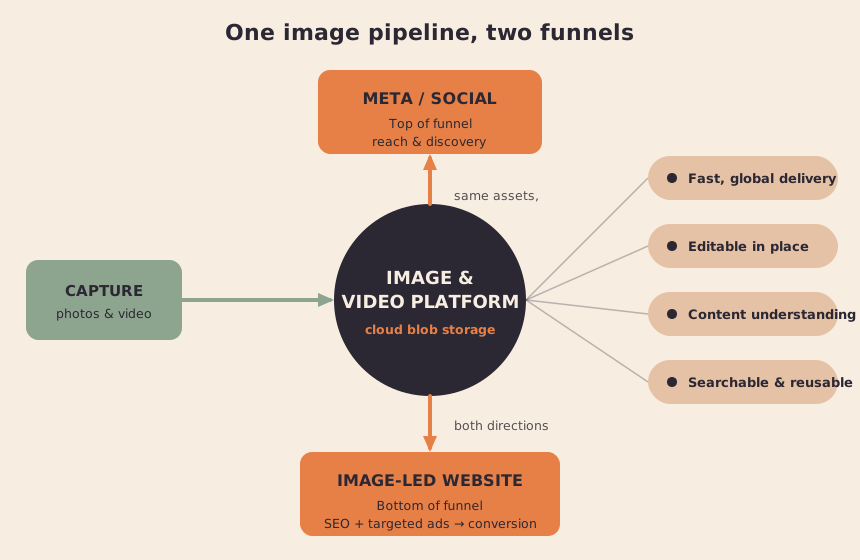
This is the part that changes the economics. When the website is as visually alive as the feed, sending people there is no longer a downgrade. It becomes the strongest room in the building: one you own, one you can measure, and one you can deliberately engineer to convert.
Top of funnel and bottom of funnel, from the same shelf
The reason this matters is that the two funnels have opposite jobs, and a single image platform is what lets you serve both without doubling the work.
- The top of the funnel wants volume, freshness, and emotion. Social rewards a constant stream of new visuals, and a central platform makes publishing them effortless rather than a weekly scramble.
- The bottom of the funnel wants relevance and intent. An image-led website can rank for the specific experiences people search for, and targeted ads can send high-intent traffic to pages that finally show the full richness of what is on offer.
Same assets, both directions. The shoot that earns the impressions on Monday is the same shoot that lifts the landing page on Tuesday. Nothing is captured twice, and nothing is stranded in a channel that cannot close.
Why this only works if the image layer is built for it
There is an honest catch, and it is the same constraint I have written about before. A workflow that puts hundreds or thousands of images at the centre of the experience only holds together if the layer underneath is genuinely built to deliver them at scale, rather than a folder bolted onto a page-oriented CMS.
In practice, an image layer fit for this job needs a few specific qualities:
- Fast, global delivery. Assets live in cloud object storage on a hyperscaler and reach every end consumer quickly, with predictable latency as traffic grows rather than the exponential degradation traditional hosting hits under image-heavy load.
- Editable in place. Crops, variants, and updates happen at the source, so a change propagates everywhere the asset is used instead of being re-uploaded channel by channel.
- Content understanding. The platform knows what is in each image, so visuals can be selected by context, season, mood, or campaign rather than dug out of a flat folder by filename.
- Searchable and reusable. Because the platform is indexed and queryable, the same asset can be found and reused across the website, social, and advertising without duplication.
These are exactly the capabilities this platform is built to provide, and they are not a nice-to-have bolted on at the end. They are what makes an image-centric workflow possible at all. Without them, "put images at the centre" stays a slogan; with them, it becomes the default way the system behaves.
My position
Tourism does not have an attraction problem. The feeds prove that every day. It has a workflow problem, and the workflow runs backwards.
As long as images are treated as an output to be pushed into a single channel, the cycle will keep breaking at the exact point where it should convert. Flip the model so that capture flows into one fast, editable, content-aware, searchable platform, and the same visuals can power both the reach of social and a website built to close. The funnel stops leaking not because you found a better channel, but because you finally gave your best material a place to work in every direction at once.
The brands that make that shift will not just look more vibrant than their competitors. They will convert the demand they were already creating, and quietly stop handing it away.
This is exactly why the image and video platform sits at the centre of everything we build at Proudback. We developed it because the workflow described here only works when the media layer is genuinely engineered for it, and we wanted tourism brands to be able to run it as the default rather than the exception. It is not a feature bolted onto a website; it is the foundation the website, the social reach, and the advertising all draw from.
If your best photos are living on Instagram while your conversions are not, it is worth a proper conversation. Arrange a 30-minute call with us and we will walk through what an image-centric workflow would look like for your specific experiences, with no obligation beyond a clearer picture of what is possible.