
A growing share of trip planning no longer starts with a search box. It starts with a question put to an assistant: "best small-group wine tours near Perth," "family-friendly wildlife experiences close to Rockingham," "what should I book for a rainy day in Fremantle." The traveller reads a short, synthesised answer naming a handful of operators, and often acts on it without ever scrolling a page of blue links.
This is a structural change in how demand is discovered, and it has a hard technical consequence. An assistant can only recommend a business whose information it can read, parse, and trust. If an operator's site is thin, unstructured, or locked inside images and PDFs, the assistant has nothing to work with and simply names someone else. The booking is lost before the operator knew there was a question.
This article sets out what "AI-readable" actually means in technical terms, why most tourism sites currently fail at it, and why fixing it favours direct bookings over marketplace dependence.
How an AI assistant decides who to name
It helps to be precise about what these systems do, because the mechanics determine what you need to fix.
When a traveller asks for a recommendation, the assistant does not browse the web like a person. It draws on a combination of indexed content, structured data it has already extracted, and, increasingly, live retrieval where it fetches and reads specific pages at query time. In every one of those paths, the same thing matters: the relevant facts about your experience have to exist as machine-readable text and structured data, not as an impression a human would form by looking at your homepage.
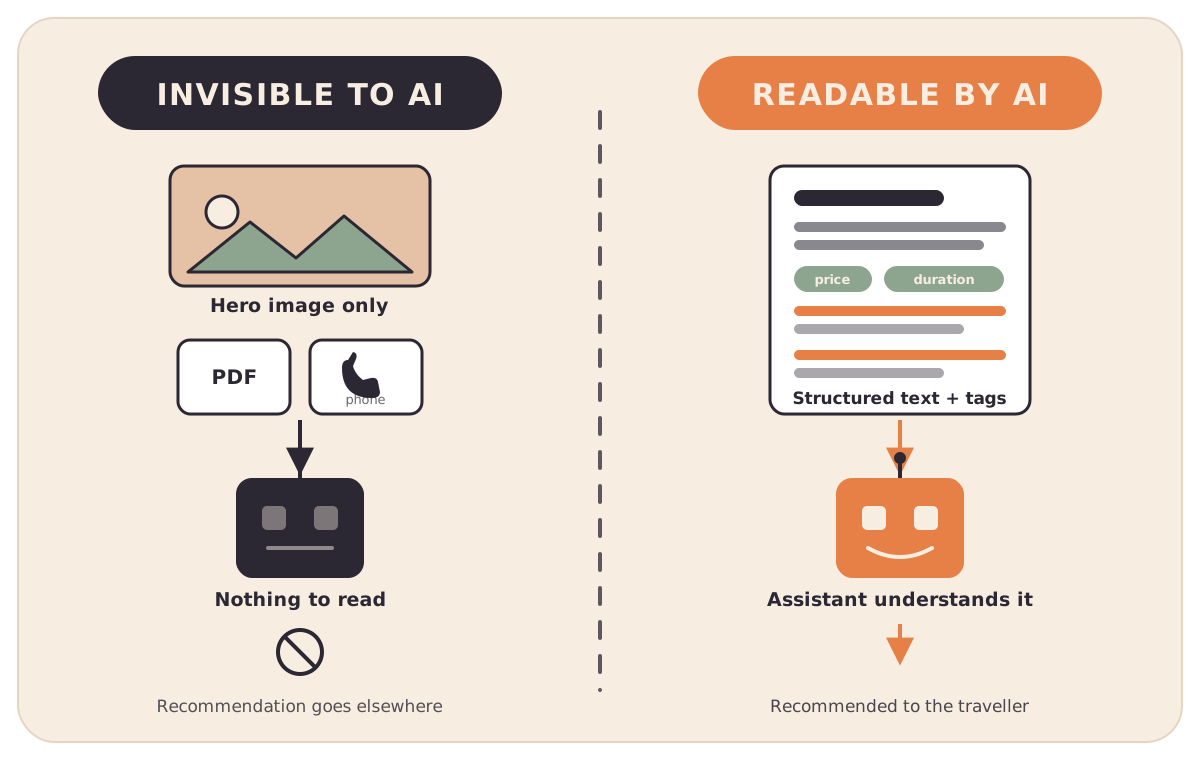
Concretely, an assistant answering "best half-day wildlife tour near Perth for families" is trying to resolve a set of attributes. What is the experience. Where does it run. How long. What price band. Who is it suitable for. What do past customers say. An operator whose site states those facts clearly, in text and in structured markup, is a candidate. An operator whose information exists only as a bare hero image and a phone number is invisible to the question, not because the image is wrong, but because nothing tells the machine what the image shows.
Why most tourism sites are currently invisible
Tourism has an unusual problem here. It is one of the most visually rich industries, and that strength becomes a liability when the audience is a machine.
The typical operator site leads with a striking image, carries a short paragraph of atmospheric copy, and puts the concrete details, departure times, inclusions, suitability, pricing, into a downloadable PDF or an image of a flyer. To a human that reads as polished. To an assistant it is close to empty: the image carries no text it can rely on, the PDF is rarely parsed well, and the structured facts it needs are nowhere in the markup.
Three failures recur:
- Facts trapped in non-text formats. Itineraries, inclusions, and prices live only inside images or PDFs, with no accompanying text, rather than as readable content the image sits alongside. The single most valuable information for a recommendation is left in the one place a machine cannot reliably reach.
- No structured data. The page does not declare what it is. There is no machine-readable statement that this is a multi-day tour, that it runs from a given location, that it costs within a given range, or that it carries a certain review rating. The assistant has to guess, and guessing favours sites that do not make it guess.
- Thin, unfocused content. A single generic "Tours" page tries to cover six different experiences. Nothing on it answers a specific question well, so it ranks and retrieves poorly against operators who give each experience its own clearly described page.
None of these are design problems. They are content-architecture problems, and they sit underneath whatever the site looks like.
What "AI-ready" means in practice
Making a tourism site legible to assistants is not a marketing exercise. It is a set of concrete, technical properties, and they overlap almost exactly with what makes a site rank well in conventional search and convert well for humans.
- Structured data on every key page. Each experience page should declare itself in machine-readable markup, the kind of
TouristTrip,FAQPage, and review structured data that lets a system extract what the experience is, where it runs, what it costs, and how it is rated without inferring it from prose. - Images as enriched assets, not dead ends. Photography stays at the centre, where it belongs. But each image should carry descriptive text and structured metadata that state what it shows, so the picture does the emotional work for the human while the bound text does the explaining for the machine.
- One page per clearly defined experience. A focused page that thoroughly describes a single tour will be retrieved and recommended far more reliably than one page that vaguely covers everything.
- Genuine question-and-answer content. Travellers ask assistants the same practical questions they would ask a guide. A page that answers those questions directly, in plain text, is exactly what a retrieval system looks for.
- Authoritative, consistent signals. A clear location, consistent business details, and visible, structured reviews give an assistant reasons to trust and surface the business rather than a competitor.
The important point is that this is plumbing, not styling. It is the same structured foundation that helps conventional SEO and gives human visitors a clearer, faster page. AI-readiness is not a separate project competing with those goals; it is the same work, finally done properly.
Images do not have to be the blind spot
There is an apparent contradiction to address directly, because it matters to how tourism brands think about this. We have argued for years that the image is the centrepiece, that in this industry a photograph sells the experience better than any paragraph. Now we appear to be saying the opposite: put everything in text, because machines cannot read images.
Both are true, and the resolution is the whole point. A photograph absolutely speaks louder than a thousand words to a human being. The problem has never been the image. The problem is the bare image: a beautiful file with nothing attached that tells a machine what it depicts. An assistant looking at an unlabelled hero shot sees a blob of pixels; the meaning a human reads instantly is simply not present in a form it can use.
The answer is not to remove the image. It is to enrich it. An image can be delivered as a complete asset: the visual itself, plus the descriptive text and structured metadata bound to it, plus the context of what the experience in the frame actually is. Done this way, the same asset that moves a human emotionally also tells a machine, this is a half-day wildlife tour near Perth, suitable for families, photographed at this location. The image stays the centrepiece. It just stops being a dead end.
This is precisely how Proudback handles imagery. Images are treated as first-class, enriched assets rather than decorative files dropped onto a page. Each one is delivered extremely fast through a dedicated image platform, and it carries the descriptive content beneath it that explains what it shows. The result is the best of both worlds: the visual impact that sells the experience to a person, and the structured, readable meaning that lets an assistant understand and recommend it. Speed matters here too, because a page that loads its imagery instantly is also a page that is cheaper to crawl and retrieve.
In structured-data terms, that enrichment is expressible directly. An image can declare what it is and what it shows, for example:
{
  "@context": "https://schema.org",
  "@type": "ImageObject",
  "contentUrl": "https://example.com/wildlife-tour-perth.jpg",
  "caption": "Small group on a half-day wildlife tour near Perth",
  "description": "Guided half-day wildlife experience near Perth, suitable for families, departing from Hillarys Boat Harbour.",
  "representativeOfPage": true
}
A machine reading that knows exactly what the photograph depicts and how it relates to the experience on offer. The human still just sees a great photo. That is the difference between an image that is invisible and an image that works for discovery as hard as it works for emotion.
Why this favours direct bookings
There is a strategic dimension that tourism operators should not miss.
For years, the path of least resistance for visibility was to list on a marketplace and accept the commission. The OTA had the structured data, the reviews, and the search presence, so when a traveller searched, the marketplace surfaced and the operator paid for the privilege.
AI-driven discovery quietly changes the incentive. When an operator's own site is the well-structured, authoritative, machine-readable source for their experiences, the operator becomes a direct candidate for recommendation, on their own domain, with their own booking path, keeping the customer relationship and the margin. The structured foundation that makes a site readable to an assistant is the same foundation that lets the operator compete for discovery without renting it back from a platform.
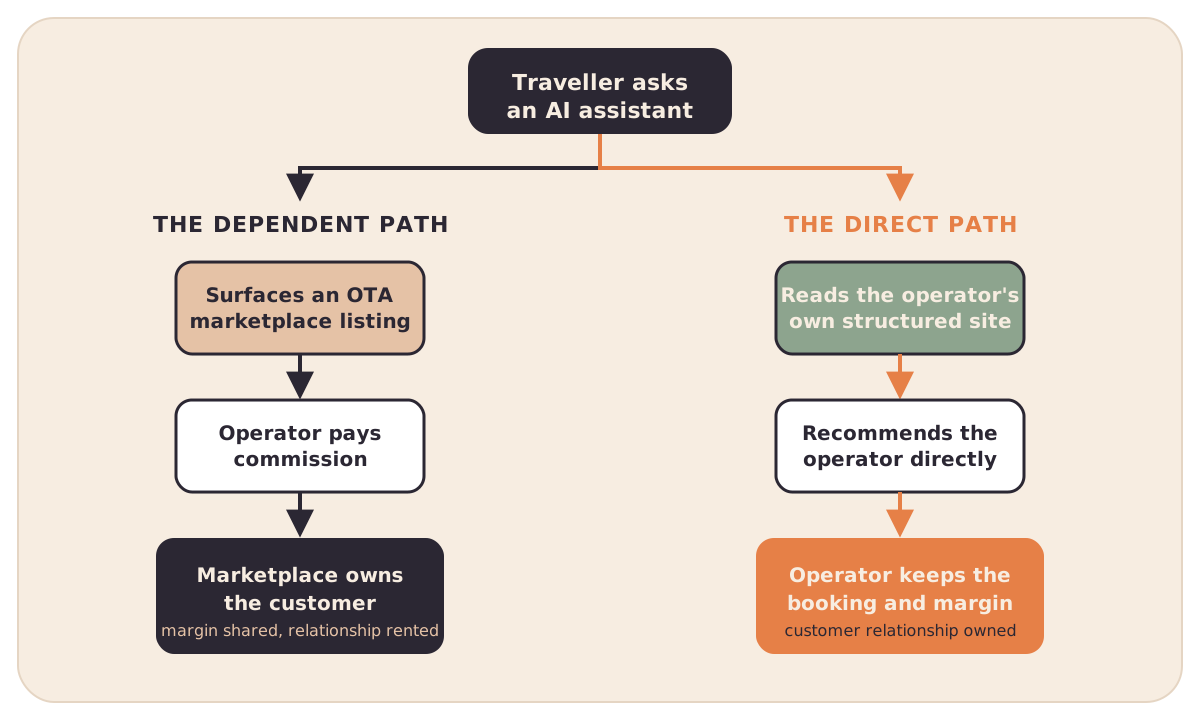
This does not make marketplaces disappear, and for many operators they remain a useful channel. But it shifts where the leverage sits. The operators who invest in a structured, content-rich, machine-readable site are positioning themselves to be recommended directly, at the exact moment the discovery layer is moving toward assistants that reward precisely that.
The Proudback position
AI-driven discovery is not a trend to monitor from a distance. It is already changing which operators get named when a traveller asks for a recommendation, and the deciding factor is unglamorous: whether the facts about an experience exist as structured, machine-readable content rather than as an image and a phone number.
The work this requires is not cosmetic. It is structured data, text-based facts, focused per-experience pages, and genuine question-and-answer content, the same foundation that has always served conventional search and human visitors well. The difference is that the cost of neglecting it used to be a slightly lower ranking. Now it can be total invisibility to an entire and growing channel of demand.
This is one of the reasons the platform we build at Proudback treats content as structured, addressable data rather than free-form text poured into a page, and treats images as enriched assets that carry their own meaning rather than as decorative files. Experiences, and the photographs that sell them, are described in a form that is legible to humans and to machines, which is what makes a site a candidate for recommendation in the first place.
If you want to know whether your current site can be read and recommended by an AI assistant, it is worth a direct look. Arrange a 30-minute call with us and we will walk through where your experiences stand today and what it would take to make them visible to the way travellers are starting to search.